


Skool
4.2665.00 Reviews
App Specs
- Version
- 1.0.57
- Updated On
- License
- Free
- Downloads
- 1,000,000+
- Developer
- skool.com
- Categories
- Social
- Platform
- Android, iOS
Screenshots
 Analysis by AppCompare
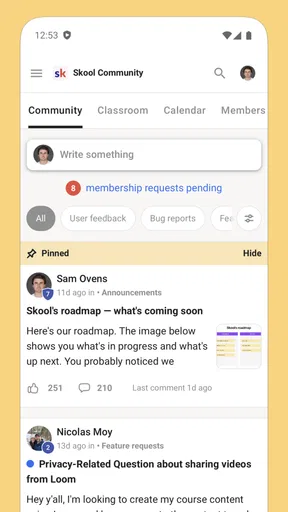
I would start with the most important distinction: Skool is a social app for staying involved with communities, not a student planner. That matters if you arrive expecting class schedules, assignment reminders, or a shared schoolwork dashboard. The published description of school tasks in older reviews does not match the app’s role. From my perspective, it makes more sense to judge Skool by how well it helps members follow conversations and keep up with groups while away from a computer.
Readable screens, with navigation shaped by the community
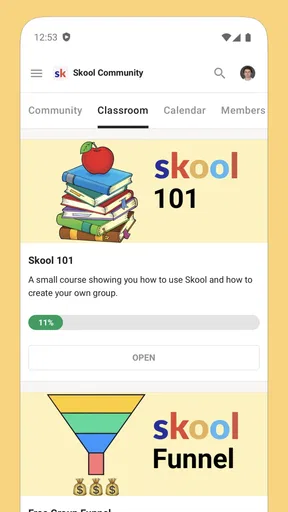
The official Skool app is made by skool.com, and its central purpose is to keep people connected to their communities on the go. That is a useful fit for groups built around learning, interests, or ongoing discussion: instead of treating each visit as a separate one-off chat, members have a community space to return to. I’d consider it when a group already uses Skool and I want a more convenient way to check in from a phone.
For readability, the key question is less whether an app has a polished home screen and more whether its community structure makes sense to you. A busy group can produce a lot to scan, while a focused community may make it easy to spot the conversations that matter. I recommend joining with a small goal in mind—such as checking one discussion or catching up on a particular topic—rather than opening the app with the vague intention of reading everything.
Skool is free, has a Teen content rating, and its current version is 1.0.40. It was released on June 1, 2023, and supports devices running Android 9 or later. Those details make it easier to judge basic fit before downloading: the age rating is not a substitute for checking whether a particular community is suitable, and the Android requirement is worth checking if you use an older phone. Its 4.0 average from around 4,300 ratings, alongside more than 1 million installs, suggests that it has found an established audience, though those figures cannot tell me whether a specific group will be active or useful.
Motor and sensory needs in everyday use
Using a community app on a phone can be handy when I have only a moment, but it also means reading and interacting on a smaller screen. If scrolling, typing, or switching between long discussions is tiring for you, a quick mobile check-in may work better than trying to handle a detailed conversation all at once. I’d save longer replies for a time and device that feel comfortable, and keep phone sessions focused on catching up or leaving a short response.
Notifications are another practical trade-off. They can help bring a conversation back to your attention, but frequent alerts can interrupt concentration or feel overwhelming. I’d be selective about what I allow to interrupt me, then make a deliberate visit when I have the attention to read. That approach is useful for people who are sensitive to repeated prompts, and for anyone trying to keep community activity from taking over study, work, or rest.
Access depends on where and how you participate
Skool’s phone-first appeal is straightforward: I can keep in touch with a community while away from my desk instead of waiting until I’m back at a computer. A realistic use is checking a group during a lunch break, noting which conversation deserves a longer reply, and returning later when I can give it proper attention. That is more sustainable than trying to follow every thread in spare seconds.
Worth Reading Before You Choose

Flipboard Shows What News Apps Must Do Beyond the Feed

Switching to Android Auto Means Rethinking Your Driving Routine

Google Calendar Makes a Crowded Week Easier to Manage

Ludo King Makes the Most of the Minutes Between Plans

Baby Panda World Brings Quick Play to Modern Phones, but Its Game Library Feels Busy

ESPN’s Live Game View Makes Following Close Games Easier
It is not automatically the right tool for every group or every kind of communication. If your friends, class, or team already organize everything in a messaging app, moving discussions to another service may split attention rather than improve it. A general social network can be a better choice for casual updates across many contacts, while a familiar group chat can be more direct for quick coordination. Skool makes the most sense when the community itself is where the ongoing activity already happens.
What to weigh before joining
A community app is only as useful as the people and discussions inside it. An inactive group gives me little reason to return, while a very busy one can make it hard to separate useful posts from background conversation. Before relying on Skool, I’d check whether the community has a clear purpose and whether its pace suits me. I’d also think about how much of my attention I want social notifications to claim; being able to stay connected is helpful only if it does not become another stream I feel obliged to monitor.
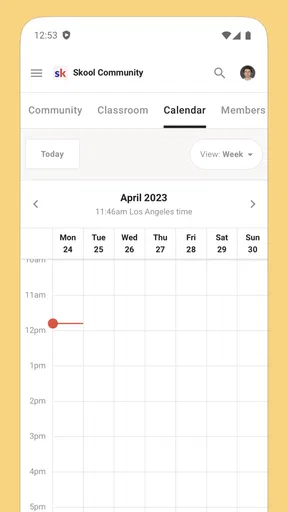
Skool is also not a replacement for a dedicated accessibility tool, a calendar, or a task manager. If your main need is tracking deadlines, planning a school week, or organizing private notes, choose an app built for that job and use Skool only if a community connection is useful alongside it. That distinction is especially important for students: a group discussion might support learning, but it should not be mistaken for an assignment system or an official record of coursework.
My verdict on inclusive, practical use
Ever stumbled upon an app that just makes your life a little easier? That's exactly how I felt when I discovered Skool. I mean, let's be honest, managing schoolwork can sometimes feel like herding cats. But this app? It's like having a personal assistant right in your pocket. Let me take you through my experience with Skool.
Getting Started
First off, downloading the app was a breeze. Available on both Android and iOS, you just head over to your respective app store and in a few taps, you're ready to roll. Setting it up was as easy as pie. You just input your school details, class schedule, and voila! You're all set.
User Interface and Experience
The user interface is clean and intuitive, which is exactly what you want when you're juggling assignments and deadlines. The dashboard gives you a quick snapshot of your upcoming tasks. I particularly love the color-coded calendar that lets you see deadlines at a glance. It's so straightforward that even if you're not tech-savvy, you'll find your way around in no time.
Features that Stand Out
One of the features that really stood out to me is the reminders. You can set them up for assignments, exams, and even extracurricular activities. And let's be real, who doesn't need a little nudge now and then to stay on top of things?
Another cool feature is the ability to share notes with classmates. It's like having a virtual study group, minus the hassle of finding a common meeting time. You can upload documents, share resources, and even chat within the app. It's collaborative learning at its finest.
Performance and Reliability
In terms of performance, Skool runs smoothly without any hiccups. I never experienced any lag or crashes, which is a big plus. The app updates are regular, ensuring everything runs like a well-oiled machine.
Final Thoughts
Overall, Skool is a game changer for students. It combines functionality with ease of use and provides a seamless experience that helps you keep your academic life organized. Whether you're a high schooler or in college, this app is a must-have. Trust me, once you try it, you'll wonder how you ever managed without it.
So, if you're looking to make your educational journey a tad bit smoother, give Skool a whirl. It's like having a personal assistant for your academic life, and who wouldn't want that?
Because the published piece describes school planning tools that are not part of Skool’s stated purpose, I would not rely on its claims about class schedules, calendar colors, assignment reminders, or uploading notes as a guide to what to expect. That mismatch is more than a wording issue: someone downloading it to manage deadlines could leave disappointed. I’d approach it as a community companion and assess it on whether it makes participation in a group easier, not on whether it can replace a planner.
A better way to use a community app on a busy day
One practical routine is to check in briefly at a predictable time instead of responding to every notification as it arrives. For example, if I’m following a professional learning group, I might use a commute break to scan for a discussion worth saving in my attention, then write a thoughtful answer later when I can concentrate. This separates discovery from response and can reduce rushed, low-context replies. It also gives people who type slowly or find phone screens tiring a way to participate without having to compose everything on the spot.
For a study group, I’d treat Skool as a place to exchange perspectives rather than as the authoritative source for deadlines or course instructions. A classmate’s explanation can be useful, but I would still check the course’s official materials before acting on important information. That simple boundary makes a community valuable without confusing peer discussion with a school’s formal communication.
Small habits that make participation more manageable
Before joining a discussion, I find it helpful to ask what I want from that visit: a quick sense of what people are discussing, an answer to one question, or a chance to contribute. That keeps a broad community feed from turning into an open-ended task. If a thread is long, I would read enough to understand its context before replying rather than posting a question that may already have been answered. This is a modest habit, but it makes mobile participation more considerate and saves time.
I would also separate “interesting” from “urgent.” A community post may be worth returning to without needing an immediate response. If the group’s activity becomes distracting, setting a personal check-in routine is more realistic than expecting constant availability. The trade-off is that slower visits can mean missing a fast-moving exchange, but that is often preferable to letting a social app dictate the day’s rhythm.
Who is likely to benefit—and who may prefer something else
I’d recommend trying Skool if you already belong to a community that uses it and want a mobile way to stay involved. It may suit people who learn through discussion, want to follow a shared interest, or need to keep up with a group while away from a computer. The strongest reason to use it is not the promise of a feature checklist; it is that a particular community gives you enough useful conversation to justify returning.
I’d skip it if you are looking for a standalone school organizer, a private notes archive, or a universal chat app for people who are not already gathered in a Skool community. In those cases, a calendar, note-taking app, or the group’s existing messenger is likely to be more direct. Installing another social app just to recreate conversations that already work elsewhere can add friction rather than remove it.
Making the experience more comfortable across different contexts
Accessibility is personal, so I would not assume that one interface will feel equally easy for everyone. People who prefer larger screens, physical keyboards, or longer reading sessions may find it more comfortable to do substantial reading and writing away from a phone. Someone who has limited time or energy could instead make short visits and focus on one thread. Those are workflow choices, not guarantees about particular accessibility controls.
For sensory comfort, I’d pay attention to how the community’s activity affects me: a quiet group and a high-volume group create very different experiences, even within the same app. If frequent alerts are distracting, I would look for ways to reduce interruptions through the device’s notification settings and choose intentional times to check in. If reading dense conversations is difficult, focusing on one topic at a time can be easier than trying to absorb a whole feed in one sitting.
These adjustments have limits. A short visit is not enough for every conversation, and a phone may not be the best device for composing a detailed post. Someone who needs specialized assistive support should test the app in their own setup before making it central to an important group. The useful question is not whether Skool is universally accessible, but whether its community format and the way you access it work for your particular needs.
How it sits beside familiar social tools
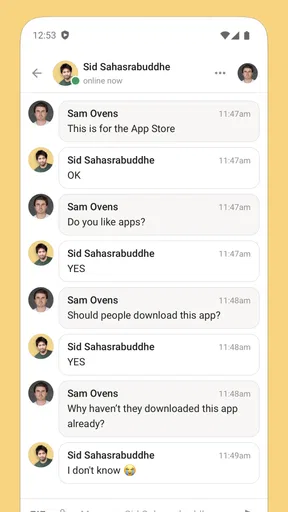
Compared with a general social network, Skool is most compelling when the group itself is the reason you are there. A broad network is better for keeping up with a varied circle of contacts and casual updates; a messaging app is often better when a few people need quick back-and-forth coordination. Skool’s role is narrower: it can be a place to return to shared community activity rather than another all-purpose stream. That focus can help when members want a common home, but it is not a reason to move a group that already communicates comfortably elsewhere.
Before investing time in it, I’d ask the community organizer how members are expected to use the space and whether important information is also shared through a more dependable channel. For a casual interest group, missing a day may not matter. For study, work, or support discussions, knowing where essential updates appear can prevent confusion. A clear purpose and a pace that suits you are better signs of fit than the number of posts you see.
My inclusive verdict
Skool can be a practical way to keep a community within reach, especially when I already have a reason to return to that particular group. Its mobile convenience is most useful when I choose how and when to participate, rather than treating every conversation as something that demands an immediate reply. At the same time, it should not be mistaken for a school planner, a substitute for official course communication, or a universal solution for every access need.
My recommendation is conditional but clear: try it if a community you value is active there, then judge the experience by the quality of the discussion and how comfortable it is for you to follow. If you mainly need reminders, deadlines, or quick messages with a small group, choose a tool designed around that need. The best setup may be Skool alongside those tools, with each one doing a distinct job instead of asking a social app to organize your whole life.
Pros
- User-friendly interface for smooth navigation.
- Rich collection of educational resources.
- Offline access for learning on the go.
- Customizable study schedules.
- Interactive quizzes enhance retention.
Cons
- Limited free content availability.
- Requires strong internet for video streaming.
- Occasional app crashes reported.
- Subscription model can be costly.
- Some features locked behind paywall.
FAQs for Skool
What is Skool, and how does it work?
Skool is an innovative educational app designed to enhance learning experiences by providing interactive lessons and resources. It offers a wide variety of courses across different subjects, allowing users to engage in learning at their own pace. The app integrates multimedia content, quizzes, and progress tracking to ensure a comprehensive educational journey.
Is Skool suitable for all age groups?
Yes, Skool caters to a broad audience with content tailored for different age groups, from young learners to adults. It categorizes courses based on age and difficulty level, ensuring that users find the material appropriate for their learning stage. This makes Skool an adaptable tool for lifelong learning.
Does Skool require an internet connection to function?
Skool primarily requires an internet connection to access its extensive library of courses and resources. However, it offers an offline mode for certain features, allowing users to download content for later use when an internet connection might not be available, providing flexibility in learning environments.
Are there any subscription fees for using Skool?
Skool offers a freemium model, meaning users can access basic features at no cost. For more advanced features and exclusive content, users can opt for a subscription plan. The app provides various pricing tiers, catering to different budgets and learning needs, ensuring access to enhanced educational tools.
How does Skool ensure the quality of its educational content?
Skool collaborates with experienced educators and industry professionals to develop its content, ensuring high educational standards. The app regularly updates its courses to include the latest information and teaching methods. Additionally, user feedback plays a crucial role in refining and improving the app’s offerings.


